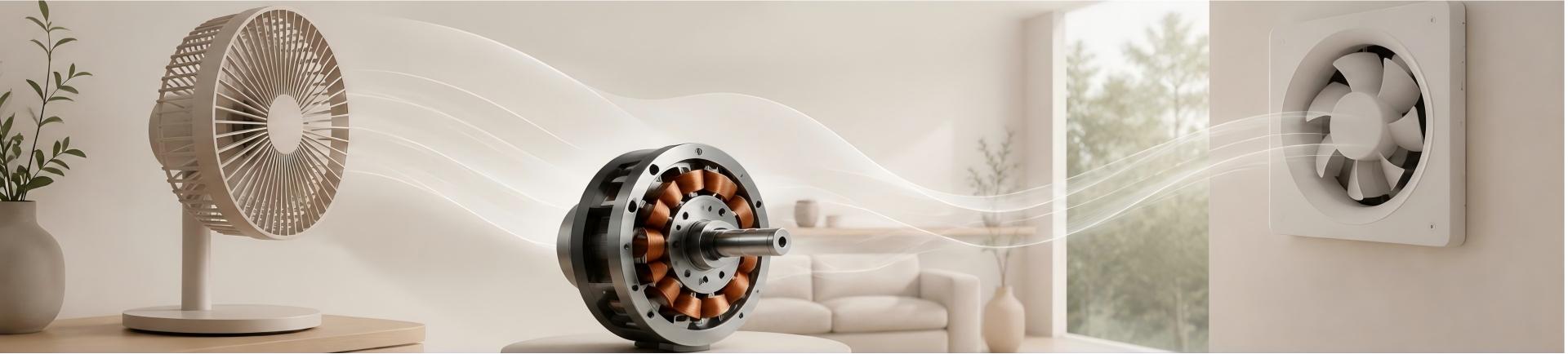
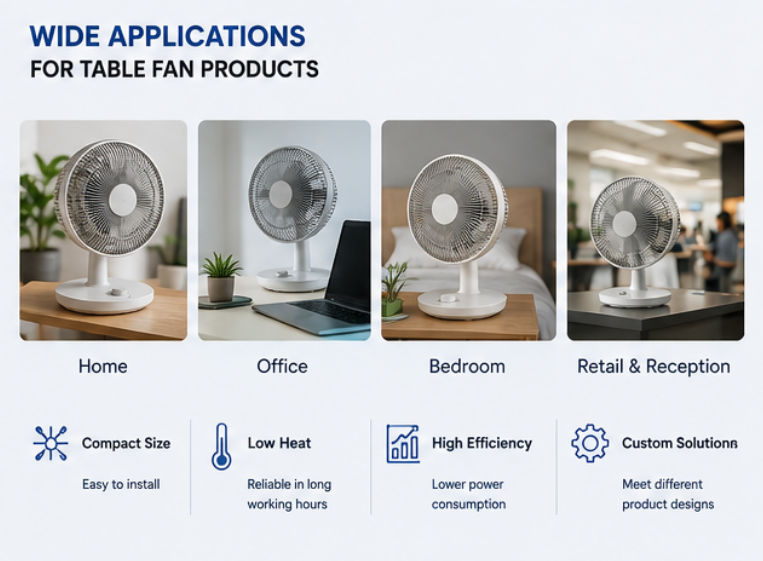
Table fans are widely used in bedrooms, offices, reception areas, dormitories, retail counters, and other compact spaces. Because the fan is normally positioned close to the user, motor noise, airflow stability, speed response, and operating temperature directly affect the finished product.
In this application case, customized BLDC Motors were developed for a compact table fan requiring several speed levels, smooth starting, low operating noise, and reliable continuous operation. Instead of selecting a standard motor only by rated power, the motor was matched with the fan blade, housing, driver board, and control system.
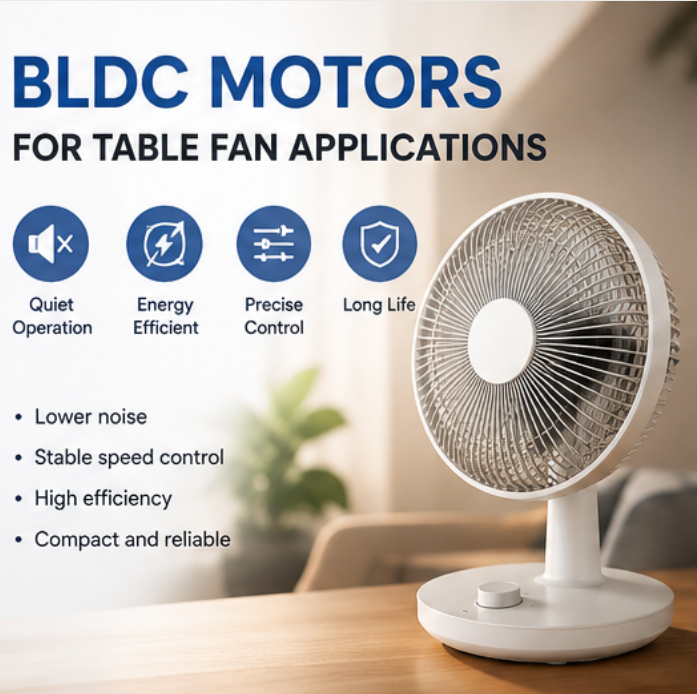
The customer needed a new table fan motor that could fit an existing rear housing without major structural changes. The original motor provided basic airflow but offered limited speed adjustment and produced noticeable vibration at certain operating speeds.
The main requirements included:
Stable rotation at low speed
Smooth switching between airflow levels
Lower mechanical and electromagnetic noise
Reliable starting under fan blade load
Controlled temperature during long operation
Compact dimensions for the existing housing
Consistent performance during batch production
A customized BLDC motor for table fan applications was selected to meet these requirements.
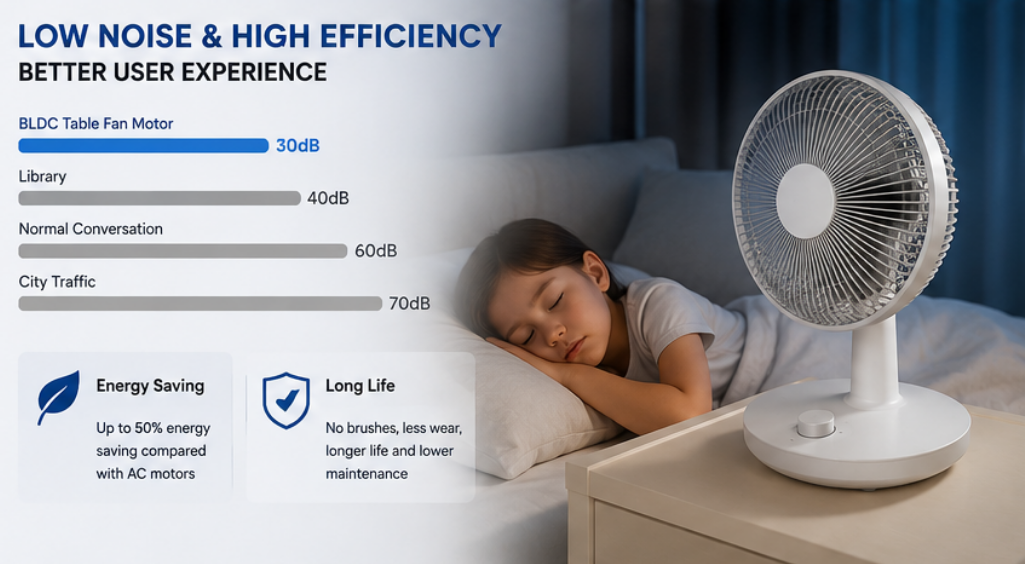
Unlike traditional brushed motors, BLDC Motors use electronic commutation. This allows the motor driver to control rotational speed more accurately while reducing wear caused by mechanical brushes.
For table fan applications, this motor technology provides greater flexibility in airflow adjustment. The fan can support several fixed speed levels, natural wind mode, sleep mode, timer operation, or stepless speed control.
Low-speed performance is important for bedside and desktop use. The motor must rotate continuously without hesitation, repeated restarting, or visible speed fluctuation.
The winding parameters and driver settings were adjusted according to the actual fan blade load. This helped the brushless DC fan motor maintain smooth rotation even at reduced speed.
Table fan noise may come from bearings, rotor imbalance, shaft alignment, electromagnetic vibration, blade turbulence, or housing resonance.
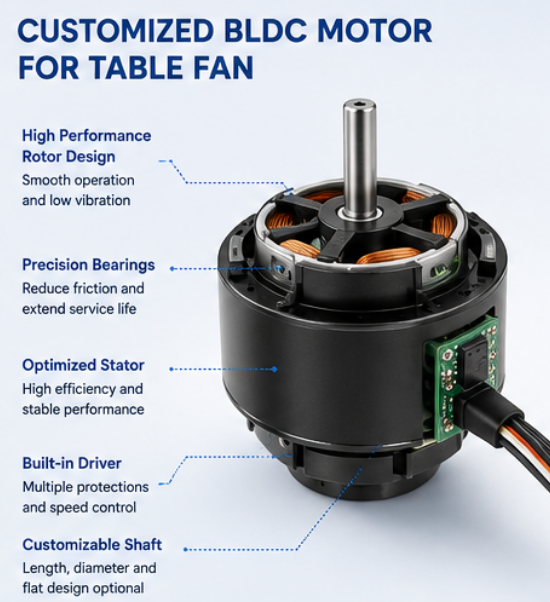
The motor structure was optimized through rotor balancing, suitable bearing selection, controlled shaft dimensions, and driver frequency adjustment. The operating speed range was also matched with the blade to reduce vibration in the assembled fan.
The fan blade creates the main load on the motor. Blade diameter, weight, pitch, material, and number of blades all influence starting torque and operating current.
A motor with insufficient torque may start slowly or fail to reach the target speed. An oversized motor may increase product cost and weight without creating a meaningful improvement in airflow.
For this project, the table fan motor was developed around the actual blade specifications.
| Motor Item | Application Requirement |
|---|---|
| Starting torque | Matched to the installed blade load |
| Speed range | Configured for several airflow levels |
| Shaft diameter | Compatible with the blade hub |
| Shaft length | Adapted to the housing and grille |
| Rotation direction | Selected according to blade design |
| Motor size | Fitted inside the rear housing |
| Control method | Connected to the fan control board |
This matching process helped maintain stable airflow while avoiding excessive current and unnecessary temperature rise.
The available installation space inside a table fan is usually limited. Motor diameter, body length, mounting holes, shaft position, wiring direction, and driver location must all fit the housing.
The shaft dimensions were customized according to the fan blade hub. Correct shaft length is important for maintaining blade position and preventing contact with the front grille.
The motor mounting points were also adjusted to match the customer’s existing bracket. This reduced the need to redesign plastic components or develop new housing moulds.
The motor driver was configured to communicate with the table fan control board. Depending on the product design, the system can support:
Push-button controls
Rotary speed adjustment
Touch-sensitive panels
Remote control
Timer settings
Natural wind mode
Sleep mode
Digital displays
The driver also manages starting behavior, speed transitions, and motor protection.
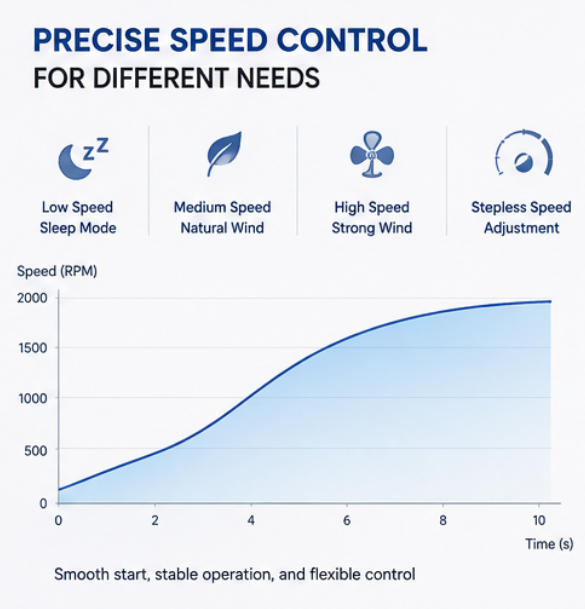
A table fan may shake or move when the blade accelerates too quickly. Soft-start control gradually increases motor speed, reducing mechanical impact on the shaft, blade hub, and supporting structure.
The customized BLDC Motors can also support locked-rotor protection, overcurrent protection, low-voltage protection, and thermal protection. These functions help protect the motor when the blade is blocked or cannot rotate normally.
Motor testing was carried out after installation in the finished table fan housing. This was necessary because blade resistance, grille structure, housing ventilation, and mounting conditions can change motor performance.
The low-speed test evaluated rotation stability, motor vibration, airflow consistency, and operating noise. The motor maintained continuous rotation without hesitation or obvious speed fluctuation.
At maximum speed, the motor current, temperature rise, vibration, and blade stability were checked. The test confirmed that the motor could handle the actual aerodynamic load.
The table fan was operated for extended periods at different speed levels. Motor winding temperature, driver temperature, and bearing condition remained stable within the required operating range.
After the winding design, shaft structure, and driver settings were adjusted, the final table fan achieved:
Smooth starting under blade load
Stable operation at low speed
Quieter motor performance
Controlled temperature during continuous use
More flexible airflow adjustment
Better compatibility with the existing housing
Consistent assembly for batch production
The customized motor also reduced later production adjustments because the shaft, mounting points, wiring direction, and speed curve were confirmed before mass production.
To develop a suitable BLDC motor for table fan products, buyers should provide the following information:
Fan blade diameter and weight
Number and pitch of blades
Target rotational speed
Rated voltage and power supply
Required speed control method
Motor installation dimensions
Shaft diameter and length
Rotation direction
Noise and temperature requirements
Expected order quantity
Complete application information allows the motor manufacturer to develop a more suitable winding, mechanical structure, and control program.
The value of BLDC Motors in table fan applications is not limited to energy efficiency. Their compact structure, precise speed control, smooth starting, and flexible driver integration allow manufacturers to develop quieter and more functional table fans.
A successful motor solution must be designed around the actual fan blade, housing space, control system, airflow target, and operating conditions. Through customized shaft dimensions, winding parameters, mounting structures, and driver programs, the motor becomes a reliable part of the complete table fan system.
Previous: Exhaust fan
Next: Pedestal fan