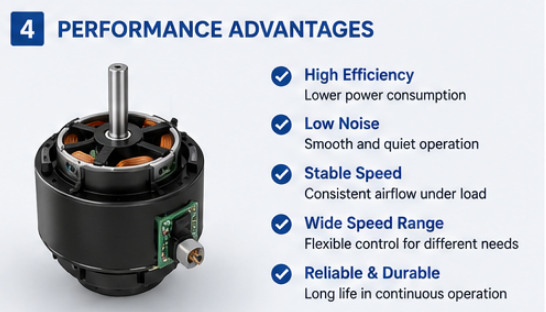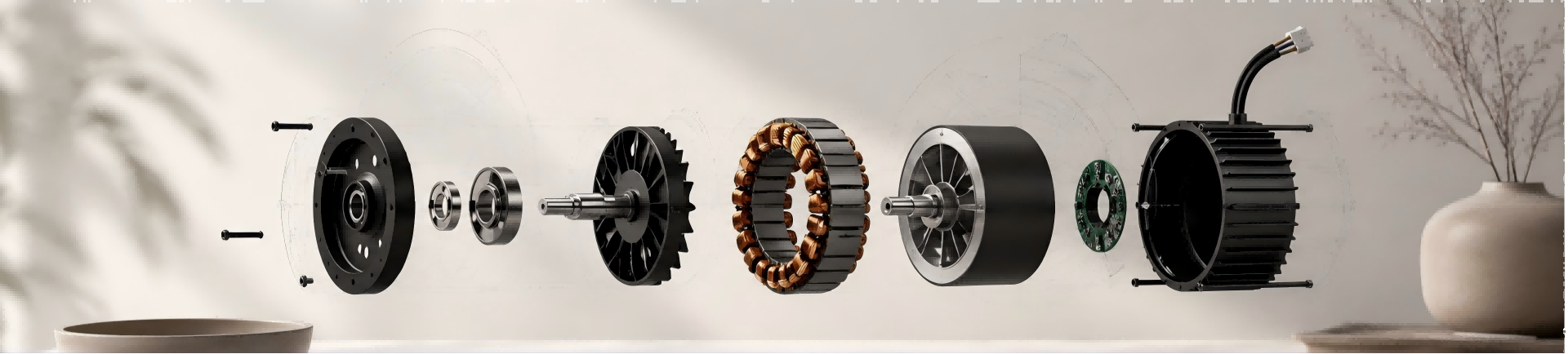
A fan motor must do more than rotate a blade. It must fit the housing, start reliably under blade load, maintain the required speed, control vibration, and work correctly with the customer’s power supply and control system.
Standard motors may be suitable during early product development, but they often create limitations when the fan enters tooling, testing, or mass production. Shaft dimensions may not match the blade hub, mounting holes may require bracket changes, or the motor speed may not deliver the expected airflow.
Our customized BLDC Motors service begins with the customer’s fan application. Motor dimensions, winding parameters, speed range, shaft structure, mounting points, cable direction, and control requirements can be developed around the actual product.
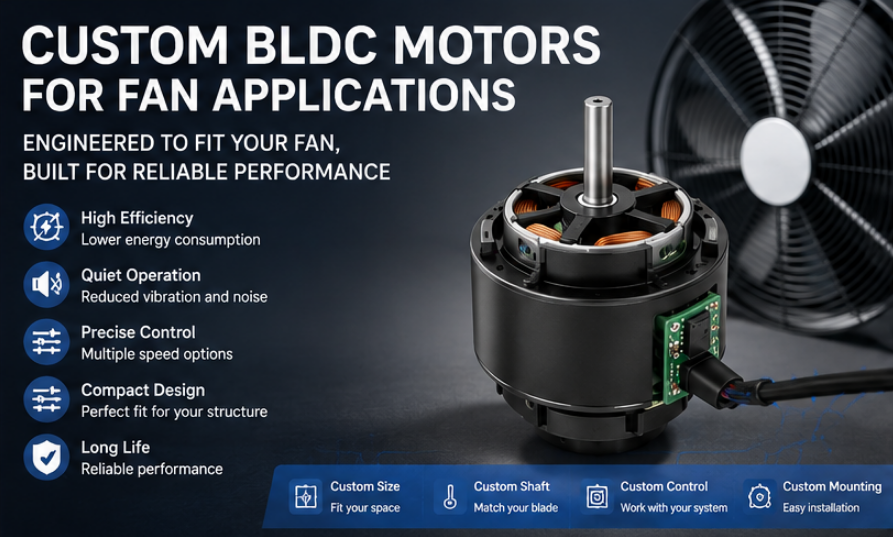
Different fan products place different loads on the motor. A compact table fan requires stable low-speed operation, while a ventilation fan may need sufficient torque to work against grilles, shutters, filters, and ducts.
For this reason, we do not recommend selecting a BLDC fan motor only by voltage or rated power. The complete fan structure must be considered before the motor specification is confirmed.
The initial engineering review may include:
Fan type and application environment
Blade diameter, weight, pitch, and material
Target speed and airflow levels
Rated voltage and power supply
Motor installation space
Shaft diameter and extension length
Mounting-hole positions
Required rotation direction
Speed-control method
Noise and temperature expectations
Continuous operating time
Estimated production volume
These details help our team define a practical motor direction before samples are produced.
Our custom BLDC motor service covers both mechanical and electrical requirements. Each project is reviewed according to the fan structure and expected operating conditions.
A motor with suitable electrical performance may still be unusable when its body, shaft, or mounting structure does not match the fan.
Mechanical customization can include:
| Custom Item | Purpose in Fan Applications |
|---|---|
| Motor diameter | Fits the available housing space |
| Motor body length | Prevents interference with covers and control parts |
| Shaft diameter | Matches the fan blade hub |
| Shaft extension | Maintains the correct blade and grille position |
| Mounting holes | Aligns with the existing motor bracket |
| Cable outlet | Keeps wiring away from rotating components |
| Connector type | Supports the customer’s assembly process |
| Rotation direction | Matches the selected blade design |
Where practical, the motor can be adapted to the customer’s existing structure. This may reduce unnecessary changes to plastic moulds, brackets, wiring routes, and assembly tooling.
The electrical specification of a brushless DC motor for fan products depends on the actual blade load and desired airflow performance.
Customization may involve:
Rated voltage
Target operating speed
Speed range
Starting torque
Rated current
Motor power
Winding configuration
Rotation direction
Speed feedback requirements
Control signal interface
Acceleration and deceleration settings
A heavier blade or a blade with a steeper pitch normally places a greater load on the motor. The winding and control settings must therefore be matched to the actual fan assembly rather than calculated from motor size alone.
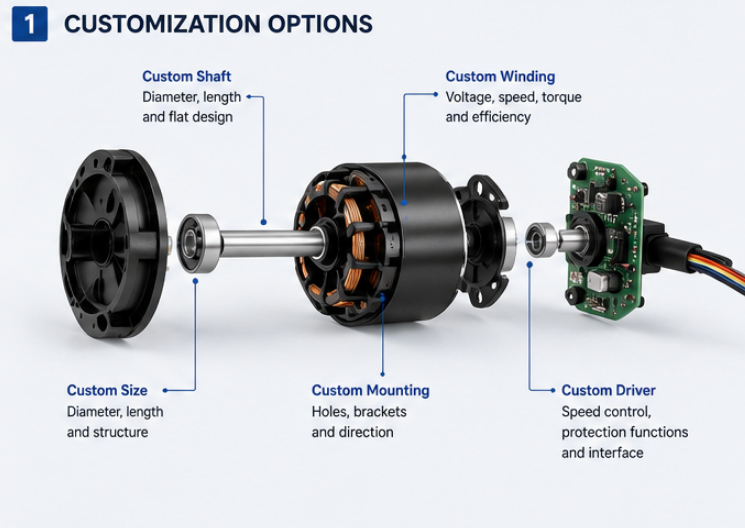
The driver is an important part of a BLDC motor system. It controls electronic commutation, speed response, starting behaviour, and protection logic.
Depending on the project, the motor and driver can be coordinated with the customer’s existing fan control board or developed around an agreed control interface.
Customized BLDC Motors can support different airflow requirements, including:
Several fixed speed levels
Stable low-speed ventilation
High-speed airflow mode
Smooth speed transitions
Soft starting
Variable speed adjustment
Timer-related speed changes
Sensor-controlled fan operation
The speed curve can be adjusted according to the fan blade and product positioning. A bedroom fan may require stable and quiet low-speed operation, while a ventilation fan may place greater emphasis on torque and airflow under resistance.
Protection requirements are reviewed according to the fan application and controller design. Available options may include locked-rotor protection, overcurrent protection, low-voltage protection, overvoltage protection, and controlled restart behaviour.
These functions are especially important when a fan blade may be blocked by dust, foreign objects, damaged shutters, or incorrect assembly.
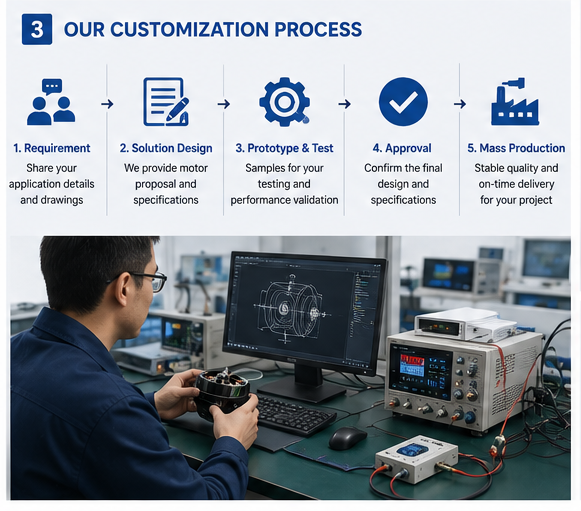
A clear development process helps reduce repeated modifications after the fan housing and tooling have been confirmed.
The customer provides available fan drawings, motor requirements, blade data, voltage information, control requirements, or an existing motor sample.
Our team reviews the application to identify key restrictions involving size, torque, speed, installation, and electrical control.
Based on the available information, we recommend a motor structure and preliminary performance direction.
The proposal may include motor dimensions, shaft specifications, mounting details, target speed, voltage, rotation direction, and control requirements.
Motor samples are produced according to the agreed specification. The samples can be installed in the customer’s fan for practical testing.
Testing the motor with the actual blade and housing is important because grille resistance, blade load, installation position, and ventilation conditions can affect motor performance.
After sample testing, winding parameters, driver settings, shaft dimensions, cable position, or mounting details can be revised where necessary.
Typical evaluation items include:
Starting performance
Speed stability
Operating current
Temperature rise
Motor vibration
Noise behaviour
Blade compatibility
Continuous operation
Start-and-stop performance
Once the motor meets the application requirements, the approved dimensions and electrical parameters are confirmed for production.
This stage helps maintain consistency between approved samples and later batch orders.
Our service is intended for companies developing or manufacturing fan products. We supply the motor solution rather than the complete finished fan.
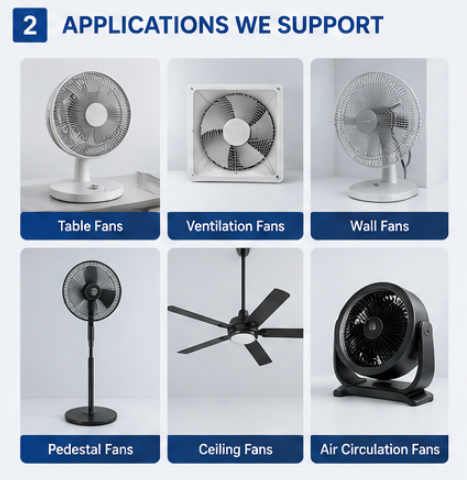
Typical applications include:
A BLDC motor for table fan products can be designed for compact installation, smooth starting, multiple airflow levels, and stable low-speed operation.
A customized ventilation fan motor can be matched to the impeller load, grille, shutter, duct resistance, housing space, and continuous operating requirements.
Motor speed, shaft design, torque output, and control settings can be adjusted for larger fan blades and wider airflow coverage.
A customized motor can support broader speed ranges, directional airflow, and different operating modes for residential or commercial air circulation products.
The motor structure can be developed around the fan bracket, blade size, installation angle, and control method.
Using a standard motor may appear faster at the beginning of a project, but mismatched specifications can cause repeated adjustments later.
Common problems include:
The shaft does not fit the fan blade hub
The motor body interferes with the housing
Starting torque is insufficient
Low-speed rotation is unstable
The motor draws excessive current under load
Temperature rises after installation
Vibration transfers into the fan housing
The driver does not match the control board
Wiring direction complicates assembly
A customized OEM fan motor helps address these issues before mass production. The motor becomes part of the fan design rather than a separately selected component.
To prepare an initial motor recommendation, customers can provide as much of the following information as possible:
Fan product type
Fan blade drawing or physical sample
Blade diameter and weight
Required voltage
Target speed
Expected airflow levels
Motor installation dimensions
Shaft diameter and length
Mounting-hole drawing
Rotation direction
Control-board information
Noise and temperature targets
Existing motor sample
Estimated order quantity
Incomplete information can also be reviewed. Our team can identify the additional details required before sample development begins.
Our service is focused on BLDC Motors, motor structures, and application matching for fan projects. We do not position this service as the sale of finished table fans, ventilation fans, pedestal fans, or circulation fans.
By concentrating on motor engineering, we can work more closely with fan manufacturers and product developers on the components that directly affect rotation, speed, torque, noise, installation, and electrical control.
Whether the project requires a new fan motor, replacement of an existing motor, or modification of a current design, our team can develop a motor solution around the customer’s product requirements.
Send us your fan drawing, blade information, motor sample, voltage requirement, or target performance data.
Our team will review the application and help define a suitable custom BLDC motor solution covering motor size, shaft structure, winding design, speed range, mounting method, cable configuration, and control requirements.
A well-matched motor can simplify fan assembly, reduce repeated structural changes, and provide a more reliable foundation for product development and volume production.